

Tuesday, January 1, 2008
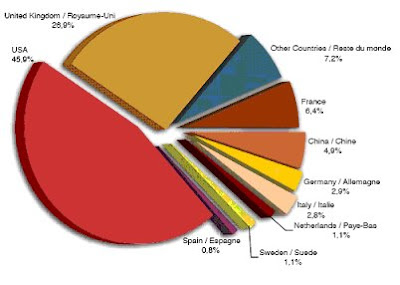
ArtPrice Report 2006
Back to our market figures, we can stress that numerous writers have analysed how the contemporary art world evolved in concordance with the culture of the members of the social relationship network within which contemporary art is produced, viewed and criticised; stressing the existence of an hegemonic power of western culture.

Big Family, Lithograph, Edition of 199, 200370cm x 82.6cm
The growth in Asian countries changes the global deal, but Chinese investors buy contemporary artworks in China, Indians in India, U.S. buy in the U.S. (also mainly due to Dollar depreciation that makes artworks 'unaffordable') and France anywhere else but in France.
I believe that this is only the first step of this 'new deal'. These changes will not only affect the content of the market, but will also change its culture: India and China will probably introduce their set of values to the contemporary art world business etiquette...
- Less differenciation (in other words we may see a low segmentation of the genres e.g. ‘expressionism’, segmented in institutionalised sub-genres such as ‘figurative expressionism’, ‘abstract expressionism’...etc);
- less hierarchisation (this means that genres won't be organised according to the value of prestige associated).
- More universalism in the art classification systems (which will also largely be enhanced by the maturity of the information transference technologies);
- finally, we may see a growing facility for artists and enterprises to move between ritualised genres.
It looks all fine to me... We may see more artists from what we used to call 'products of colonisation' affirming cultural identities without too much difficulties as the pressure resulting of not being part of what we used to call "the hegemonic western art world" may decrease.
This set of potential changes within the contemporary art world culture may therefore sign the end of the modernism... Postmodernism is only a baby... Let's hope it is a genius!

Detail from The Silk Route by Subodh Gupta ("The Damien Hirst of Dehli"-The Guardian- ArtReview). Photograph: Colin Davison
Good ole artistic trends debates may probably disappear in such conditions! No more: "My 'Nouveau Réalisme' is an answer to your 'painting and sculpture hegemony'..." or "I developed my idea of 'cubism' in reaction to your Blablablah..." Such a shame...
All these personal predictions concern the art world in market terms... What about the artists and the artworks?
Have you recently visited the Saatchi website? It now looks like a MySpace for the artists... I read in your mind that this must concern a minority as Facebook and MySpace themselves are too big to allow any serious competition... Well you may be wrong then: I read "HITS IN THE LAST 24 HOURS: 60,914,153!!!! RANK TODAY IN THE WORLD'S TOP 50.000 SITES: 227(Source: Awstats, Alexa)". It is an example among many other relevant examples. As a result of the resulting competition among artists, I see an increase of the artwork technical and aesthetic quality, already initiated by artists like Lisa Yuskavage or John Currin mentioned in the 'artwork of the month' for December in this same blog.

Jeff Koons - Model for a project... Work in progress
You can already see that artworks are more and more expensive to produce... Is it a consequence of these changes? If realized, the 161 foot tall hanging train would be located at the entrance of the Los Angeles County Museum of Art and would become a perfect illustration of the contemporary affordability to be a 'good artist' (see model above). I must admit that I am joking a bit... Koons can do it? Ok why not! It does not mean to me that someone from the other corner of the world may not impress the whole art world with a pencil, a A4 piece of paper and a great idea...
In conclusion, to YOU, the black middle class, bisexual lady from Kenya with your pencil and your A4 piece of paper... I wish you the best for 2008 and will probably see you soon in a famous contemporary art museum in China!
Happy new year everybody!
Wednesday, December 12, 2007
I say fair enough... Did you see this crack? Did you see this skull? amazing aren't they?!!
The first is a work commissioned by the Tate gallery and is only viewable in Tate modern because it's part of it. This 548ft crack called Shibboleth is here to show how the foundations of the contemporary art world are fragile. Cracking the ground floor of the HUGE turbine hall of the Tate modern was particularly clever in this sense: Tate modern is one of the biggest touristic attractions in London, one of the coolest brand (15th on the coolbrands classification... Do not believe me? Check yourself: http://www.superbrands.uk.com/pdfs/CB%20-%20Press%20Release%20-%20Announcement%20-%20Final.pdf) and a centre of gravity for the contemporary art. Cracking its foundation suggests that the contemporary art culture was built upon colonialist values and cultural imposition. "Shibboleth asks questions about the interaction of sculpture and space, about architecture and the values it enshrines, and about the shaky ideological foundations on which Western notions of modernity are built" in Salcedo's own words.
 Although the media criticize on the one hand that visitors keep on asking to the staff "how did the artist do that?!" and keep on falling in the crack... (A dozen of accidents reported!); on the other hand, to quote Jonathan Jones from the Guardian Art blog "it is a fissure that doesn't really threaten anything or anyone".
Moreover, he says "Modern art has now become the universal culture of Britain's middle class, of all ages. Yet when a really provocative and powerful contemporary work appears - I'm talking about Damien Hirst's diamond skull - the middle class runs for cover, disturbed by the impossibility of reducing this disturbing object to a liberal platitude".
Photograph: Getty
And here comes our second Artwork: Damien Hirst's Diamond Skull. For me there is nothing controversial about it. I can imagine that it may shake the common mood but honestly, having a look back in the 90's on Tracey Emin's bed, it may suffer the comparison. Remember, she brought her own bed covered of alcohol, germs and traces of her sexual activity... In Saatchi's gallery. Ok! Ok! Nothing to do with the skull, but that rocked! didn't it?

My Bed by Tracey Emin, 1998. Photograph: courtesy Jay Jopling/White Cube.
Here lies the problem. Contemporary art became popular, fashionable, cool (look at this whole blog: I do not think I m the first writing a blog about contemporary art, believing that my view got the spark that will lead me to a Worldwide Web rapid success!) And my generation acknowledged the existence of contemporary art with artists like Emin, Chapman brothers and a pope crushed by a rock came from space. In fact my first memorable artwork was the empty room presented for the Turner Prize by Martin Creed (Work No. 227: The lights going on and off 2000 (installation at Tate Britain)5 seconds on/5 seconds off, Edition 2/electrical time). In fact I found it controversial enough to bring it on the top of my hobby list... Can you imagine now why a skull and diamonds are not controversial to me? Is it controversial to you?

Courtesy Cabinet, London © GBE (Modern) New York Photo: Tate Photography
-John! come here! Take a picture of us in front of this... hmm... Nazi's cross model representing hell, crafted by the Chapman brothers!!!
Yep! Chapman's are cool too nowadays!
ART should be challenging and provocative... But please do not provoke us for free... We are bored anyway, it's all done! ;-))
http://blogs.guardian.co.uk/art/2007/12/hirst.html
http://blogs.independent.co.uk/independent/2007/10/salcedos-crack-.html
http://www.tate.org.uk/modern/exhibitions/dorissalcedo/default.shtm


