

Wednesday, May 28, 2008
I'd like to focus on a point of the debate related to the way the initial article was written in the Art Newspaper because I believe it is relevant to explore the way cultural differences affect the contemporary art world in general.
9.5.08 Jonathan San Francisco
How many of us felt the same in front of an art-related text, an introduction to a specific artist or an exhibition book/review? To be honest, if you do your first steps in the contemporary art world, it sounds like a foreign language!
To this first comment, a second writer adds:
What the writer is obscuring with his "art-speak" is that the videos featured animals being battered to death, in some cases by the artist, in the name of art. I saw the exhibit and was sickened and I've worked in hospitals all my life. What I saw when the exhibit was pulled was a demand, if you will, for ethical, humanistic and humane values rather than an "anything goes in the name of building my career." If the video had shown the torture of humans done as an art form there would have been no mistaking its brutality. I realize that most of us eat meat and that animals are usually not killed in a humane way but this exhibit wasn't about that. It was about promoting a career by using gruesome and controversial imagery.
Eventually, a third writer, visibly more concerned by what happens in the contemporary art sphere, writes:
9.5.08 Nancy San Francisco, CA
My 2¢ in response to the previous comments. Firstly, what is "art-speak"? When I hear someone use that term it always feels as though they are simply trying to dismiss the argument. This is a venue for art writing and sometimes complex and nuanced ideas require like language. Do we deride economists, carpenters or anyone that has a vernacular/vocabulary/language that we have trouble deciphering?
[...] I also wonder if Nacy's analysis that the artist is "promoting a career by using gruesome and controversial imagery" is based on an understanding of the work in context of his entire body of work/career, or simply on a knee jerk reaction and subjective view of contemporary art and artists.
9.5.08 josh Oakland
This actually makes a point here, the 'knee-jerk reference was obviously not compulsory but demonstrates a certain passion in the debate...! "This is a venue for art writing and sometimes complex and nuanced ideas require like language. Do we deride economists, carpenters or anyone that has a vernacular/vocabulary/language that we have trouble deciphering?" is a wise comment but...If you are a regular reader of these blog lines, or if you have a foot into contemporary art world as a hobby or as professional, you've probably acknowledge all the postmodernist theoretical background and would probably agree with this third writer. However a contradiction lays just there:
On the first hand, contemporary art is over mediatised and becomes increasingly popular. If not in a art-specific media, contemporary art is often introduced to the mass culture through the celebrities who bought or sold famous artworks, big amounts of cash exchanged and sometimes glittering cocktails and parties to celebrate prizes.
On the second hand, rich of a solid theoretical background and a more and more complex history of the Art and the interactions between sub-genres; contemporary art becomes less and less accessible to the newcomer but more and more interesting in my opinion although i agree that we can find the best, the worst and too often... the worst.
This is not just about the words to describe it! This is way more than just this! I am talking about visual vocabulary, the visual semantic rules and cultural history associated; the postmodernist grammar and conjugation system, which binds the artist, artworks and viewers altogether to create meaning with a unique sense of the tenses dialectic...
Therefore, how come a newcomer who never really learned this foreign language could possibly understand such complex artworks as Jim Beam JB Turner Train from Jeff Koons? Try to explain to a newcomer that this stainless steel train, filled with Bourbon is a masterpiece and talks about class, power and the contemporary art market?
 Jim Beam JB Turner Train from Jeff Koons
This definitely is a first step, although I hate when interactivity becomes compulsory in a growing number of museums...
The key lays therefore in the education process... When would we see a fully recognised picture analysis as an exam for the GCSE, baccalaureate or any equivalent?
Thursday, May 15, 2008
The artist is apparently French with North African origins (it is somehow relevant, u ll see...) and the artwork is a movie made in a Mexican slaughter house... Showing animals being slaughtered and was apparently misinterpreted by a part of the audience that saw there a kind of 'Animal Snuff Movie' realised for the sake of Art. We can't really blame them, can we? I've mentioned earlier in this blog that the art world is not being tender at the moment with projects of people dying in Art galleries for the "show" (I m not discussing these artworks here... this is a whole other debate), the story of this student with her performance art piece in which she artificially inseminated herself repeatedly and then self-aborted for the sake of art, then Guillermo Habacuc Vargas who chained a dog and left it in the gallery without food for the sake of art... It is all disturbing isn't it???
This all sound really crazy to me, however I must say my opinion is a bit biased as I belong of a specific group of people recently mediatised because of its leader actions and PR operations, and girlfriends... We became notorious in the past as some of our traditions are usually perceived as foolish: eating cow tongues and snails, being really arrogant, protesting for everything and demonstrating all the time. We are known as the French people.
My opinion is biased because there are some of the things out there I take for granted (snails are really good... yes, they really are!), some I do not understand (when I say that in France, in soap advertisements, girls appear entirely naked under the shower and, I do not understand why you think this is pervert...) and some things, my people do not accept (Chinese people eat puppies and rotten duck eggs!!).
I do not say I am any better than you, I just say that I am different... I am just French! But look, I am not only French, I went to university, come from a village, a Polish family with a catholic background... and finally I am really into contemporary art things for years... It makes things easier for me to accept or understand as it is part of my culture. In fact, we all are singular individuals, who belong to groups which belong to larger groups. Therefore, when I go to see an exhibition about Chapman Brothers artworks (notorious for being particularly controversial...), I am not really shocked. Does it mean that it would be stupid of you to be shocked there?

Some ideas could be dangerous when exported in other social groups. We have recently seen conflicts exploding all around the world because of a couple of Mahomet's drawings. What kind of conclusion could emerge from this?
Coming back to our slaughter house example, it appears as I mentioned previously, that a group of people believed that the animals were killed on purpose, for the sake of the video. It led to blackmail, dangerous anonymous threats...etc. Who is responsible?
I believe that, as in every communication process, that meaning is built both by the emitter (here the curators) and the receivers (audience). Therefore, the information about the artwork was probably lacking... This is an old habit, tradition for galleries to keep a mystery around the artworks. It is part of the art culture, usually justified by the fact that every viewer must be able to enrich the artworks by building a personal relationship with the piece of art, as many different opinions as different viewers who enter in the gallery; different meanings to be shared, to generate a result that is more powerful than the simple sum of every individually built meanings!

Saturday, May 10, 2008
High and low society, memorials and the story of the 50 meters high horse in Kent!!!
0 comments Posted by seiinod at 9:54 PMDefining whether a work of art is ‘original’ or not may depend on a stereotyped definition of originality for social coherence needs, and may thus be unresponsive to the work of those who challenge the authority of that tradition and that stereotype.

Rachel Whiterhead (see previous post here)- Memorial - JudenPlatz - Vienna
I would like to explore briefly another problem, which may lie under all this: When it comes to 'public' art.
On the one hand, there is an art world that tries to place massive art works everywhere in the UK (Shall we really complain? It s definitely a matter of point of view when it comes to pay the local taxes); on the second hand, people's desires are not necessarily fulfilled with the authorities responses... What I am just about to say may sounds like a cheap advice but I think it's worth to say it: Authorities should take account of the gap that stands between the art world culture and the people's culture!
In a previous post entitled "The contemporary art world in 2008", I introduced the potential modification of the business etiquette within the contemporary art world in 2008, due to the growing importance of the Asian markets... In parallel, for my uni final work, I introduced the hypothesis that a 'contemporary art' culture of communication may exist, largely influenced by the top end buyers who benefit from a great media coverage and therefore could be influential for minorities within the art market. A culture mainly U.S. and Europe oriented at the moment, but just about to change drastically.
 Christian Boltanski

Jüdisches Museum - Berlin
To be more precise, I've demonstrated that according to the international sales figures blended with scores associated with each countries for the cultural characteristics, that the dominant western art market tends to give little chance to artists and enterprises to move among genres, but also that no importance is accorded to these new genres unless there are values of prestige associated. In other terms it does hardly give a chance to new emerging movements, especially if those movements do not emerge from the major cultural actors of the International art market.
That is for the market culture... but what about the people's culture, which probably has nothing to do with this international financial/cultural battleground? Reading this last paragraph again makes me think that the art world would not give a damn about the people anyway!
Do you take account of the people's culture when you commission an 'angel of the south' in Kent? The fourth plinth on Trafalgar square that traditionally supports contemporary artworks? Hardly... Yes in fact but it tends to be kept hush...
John Tusa for an article in Guardian Arts Blog entitled "Art in public spaces should be decided by the people" proposes a series of questions to improve the communication process between the Commissioners and the Public:
Is the work to be a sculpture or an installation? Is it for an existing community with an existing identity, or a new community whose identity can be influenced by the commission? Is it to be permanent or temporary? If temporary, what follows? Is the commission primarily a sop to a developers' conscience, a blatant attempt to gloss over a basically mediocre development? How is the community to be involved? How is the artist involved? What is the process for choosing a short list of artists for the commission - if this is the route chosen? And finally, who chooses the actual commission?

Model for a hotel - Thomas Schütte - Photo by Orange Mac
This question can become really tricky when it comes to commission a memorial artwork. Why would we commission an artwork for a memorial by the way? Probably because in some cases, words and pictures are not enough to communicate things as 'heavy' on consciousness as holocaust, wars or genocides... There I come back to the first post of this blog, last November that introduced my vision of what a great contemporary artwork is: a way to express an idea, to reach the full-range of human feelings when words or traditional media becomes powerless.
I invite you to visit the Guardian website to have a clear view on what projects are currently competing to become Ebbsfleet Landmark (Kent). Finally, my preference would definitely go to Mark Wallinger's project... (see previous post about Mark Wallinger)

Photograph: Ebbsfleet Landmark Project Ltd
Why? Although I am deeply in love with Rachel Whitehead's work I cannot avoid to dream about my daughter at the back of the car, a spark in the eye, just thinking that in a couple of miles she will see the sculpture of a giant horse!!! ;-))
Wednesday, March 12, 2008
Defining whether a work of art is ‘original’ or not may depend on a stereotyped definition of originality for social coherence needs, and may thus according to Harrison and Wood “be unresponsive to the work of those who challenge the authority of that tradition and that stereotype”. Because we also hold stereotypes about our own culture... We may therefore imagine that there is a bias when exploring the question of our identity... Would you really think that you can be that subjective?
For example, Graciela Trajtenberg highlights in Modernism in Action: Comparing the relationship between the Visual Arts, Social class and Politics in Israeli Nation-building, that the attempt of artists affiliated with the organised labor movement, to promote an art deeply embedded in the local cultural conditions (“reflecting the political aims of the Israeli settler movement” and “with a flavour of Middle-East cultural heritage”) were countered by the contemporary art world hegemonic power.

Guy Ben-Ner -- From 'Self portrait as a family man'
Taking the problem on the reverse, studies also highlight the difficulties that an artist may encounter while trying to depict elements related to a ‘true national culture’.
By analysing the creation process of an artist who wishes to produce an artwork that might reflect his/her national culture, Fanon (1965) highlight that the exchange of influences between ‘dominant’ (here the US and European art world and its influence on the international art market) and the dominated cultures (second third and quarter world cultures that try to impose their own cultural views on the international art market) is too deep nowadays.
This artist would take the risk to come across the use of stereotypes within the depiction intention. In attempting to reach the basis of what might consist the ‘true’ national culture, artists deny the foreign culture and its influence, such as its contributions in terms of techniques and trends. Such work is therefore based on the assumption that constant recognisable patterns exists in what is considered as ‘true national art’. But Fanon, argues that “the forms of thought and what it feeds on, together with modern techniques of information, language and dress have dialectically reorganised the people’s intelligences".
In the artist attempt to depict what consists of the ‘true’ elements of a culture “turns paradoxically towards the past and away from actual events”. He/she, then illustrates the ‘cast-offs of thought’, a set of rules, norms and values that do not reflect the reality of the culture anymore.
Sunday, February 24, 2008

Laughing in a Foreign Language, from 25 January – 13 April is the first exhibition curated by The Hayward’s new international Curator, Mami Kataoka. In a time of increasing globalisation, the exhibition questions if humour can only be appreciated by people with similar cultural, political or historical backgrounds and memories, or whether it can act as a catalyst for understanding the unfamiliar. Bringing together 80 works including videos, photographs and interactive installations, many of which have not been shown in the UK before, the show investigates the whole spectrum of humour, from jokes, gags and slapstick to irony, wit and satire, as well as questioning what it means to share a sense of humour and what it is that makes an individual laugh.
Ralph Rugoff, Director of The Hayward, said;
“Laughter is universal; it is something that people in every culture can relate to. Humour however, is socially specific. This exhibition offers an alternative and fresh perspective on different cultures by bringing together artists from 22 nations around the world, including Japan, Mexico, Iran, Germany and Cameroon, and exhibiting work that asks us to explore not only the differences in culture and humour but also what unites us.”
 Cindy Sherman
Laughing in a Foreign Language explores the role of laughter and humour in contemporary art through the work of 30 international artists, including Jake and Dinos Chapman (UK); Ugo Rondinone (Switzerland); Makoto Aida (Japan); Doug Fishbone (US); John Bock (Germany); David Shrigley (UK); Jun Yang (China); Julian Rosefeldt (Germany); Olaf Breuning (Switzerland); Candice Breitz (South Africa), Matthew Griffin (Australia) and Marcus Coates (UK).
Sunday, February 17, 2008
This specific post story all started a couple of years ago, with a box in a book called "Le Marketing Sensoriel" which gives key elements to understand the "rush management" as a marketing tool (In other words, miscellaneous techniques to retain people in a crowded high street, hype shop. The box, entitled "behavioral cloaca" explains that a great number of rats were put together in a small cage for behavior observation purposes. What they've found out was that rats became hostile, gave way to cannibalism, incest and death... Then I would like you to think about the crowd in a big museum such as MOMA or TATE on a Saturday afternoon from this overcrowded point of you... OOOPS!

Joke apart, the first experiment really exists and demonstrates the influence of busy environment on living creatures behaviour. Do not tell me that you've never felt claustrophobic or agoraphobic while walking in Manchester city center on a week end. What type of impact could have the crowd on the museum visit experience? The Arts Newspaper article stresses that most of the artworks were not created to fit into galleries as they were supposed to end on a wall in the peacefull well-protected house of a rich investor... Some quite place, where you (they) can have a face to face encounter with the artwork for hours without 100 tourists taking pictures (with a powerful flash), or standing between you and the canvas. Moreover, some artworks respond to each others, are complementary. The first example that comes to my mind is the Rothko's room in Tate modern, London.


- If a pretty latina comes to seat right next to you the German little on the bench in front of this Rothko's masterpiece; it is more likely that she wants to admire the canvas rather than getting your number.
- Galleries may not become a place for hot dates
- Do not, in any case, hold such stupid stereotypes (specially the two mentioned above).
Sunday, January 27, 2008
You won't find green grass in an art gallery, but you will be able to look into the neighbour's garden...
0 comments Posted by seiinod at 1:02 AM


 Jessica Dimmock - the ninth floor
Monday, January 14, 2008

Cy Twombly, Untitled, 1970. Oil, house paint and crayon on canvas, 11' 4" x 13' 3" (345.5 x 404.3 cm).Menil Collection, Houston.
Contemporary art carries a message emitted by a source (the encoder/artist), encoded through the artwork (code), and received by the viewer (decoder) who decodes the message. Such model also entails a source of ‘interferences’ which is a deterioration of the message within the emision/reception process due to the condition in which the communication act occurs.
Number 1 Jackson Pollock 1948
Therefore, an artist might not be in full control of the meanings that are deducted from his/her produced picture or text. Francis Bacon’s famous “distorted figures” for example has been described as a depiction of the horror of war in the context of the late 1940’s for a long time whereas the intended meaning of his painting was to depict the inner pain inherent to human conditions.

Three studies for a crucifixion - Francis Bacon
In a next post I planned to show you a couple of artworks from Paul McCarthy who masters the use of noise as an integrated part of his artworks, performances and sometimes the whole exhibition. The noise as a medium. It definitely seems that everything can be a medium. It s a shame tha everybody cannot be a genius!
;-)
Tuesday, January 1, 2008
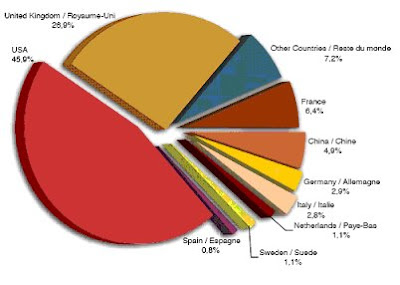
ArtPrice Report 2006
Back to our market figures, we can stress that numerous writers have analysed how the contemporary art world evolved in concordance with the culture of the members of the social relationship network within which contemporary art is produced, viewed and criticised; stressing the existence of an hegemonic power of western culture.

Big Family, Lithograph, Edition of 199, 200370cm x 82.6cm
The growth in Asian countries changes the global deal, but Chinese investors buy contemporary artworks in China, Indians in India, U.S. buy in the U.S. (also mainly due to Dollar depreciation that makes artworks 'unaffordable') and France anywhere else but in France.
I believe that this is only the first step of this 'new deal'. These changes will not only affect the content of the market, but will also change its culture: India and China will probably introduce their set of values to the contemporary art world business etiquette...
- Less differenciation (in other words we may see a low segmentation of the genres e.g. ‘expressionism’, segmented in institutionalised sub-genres such as ‘figurative expressionism’, ‘abstract expressionism’...etc);
- less hierarchisation (this means that genres won't be organised according to the value of prestige associated).
- More universalism in the art classification systems (which will also largely be enhanced by the maturity of the information transference technologies);
- finally, we may see a growing facility for artists and enterprises to move between ritualised genres.
It looks all fine to me... We may see more artists from what we used to call 'products of colonisation' affirming cultural identities without too much difficulties as the pressure resulting of not being part of what we used to call "the hegemonic western art world" may decrease.
This set of potential changes within the contemporary art world culture may therefore sign the end of the modernism... Postmodernism is only a baby... Let's hope it is a genius!

Detail from The Silk Route by Subodh Gupta ("The Damien Hirst of Dehli"-The Guardian- ArtReview). Photograph: Colin Davison
Good ole artistic trends debates may probably disappear in such conditions! No more: "My 'Nouveau Réalisme' is an answer to your 'painting and sculpture hegemony'..." or "I developed my idea of 'cubism' in reaction to your Blablablah..." Such a shame...
All these personal predictions concern the art world in market terms... What about the artists and the artworks?
Have you recently visited the Saatchi website? It now looks like a MySpace for the artists... I read in your mind that this must concern a minority as Facebook and MySpace themselves are too big to allow any serious competition... Well you may be wrong then: I read "HITS IN THE LAST 24 HOURS: 60,914,153!!!! RANK TODAY IN THE WORLD'S TOP 50.000 SITES: 227(Source: Awstats, Alexa)". It is an example among many other relevant examples. As a result of the resulting competition among artists, I see an increase of the artwork technical and aesthetic quality, already initiated by artists like Lisa Yuskavage or John Currin mentioned in the 'artwork of the month' for December in this same blog.

Jeff Koons - Model for a project... Work in progress
You can already see that artworks are more and more expensive to produce... Is it a consequence of these changes? If realized, the 161 foot tall hanging train would be located at the entrance of the Los Angeles County Museum of Art and would become a perfect illustration of the contemporary affordability to be a 'good artist' (see model above). I must admit that I am joking a bit... Koons can do it? Ok why not! It does not mean to me that someone from the other corner of the world may not impress the whole art world with a pencil, a A4 piece of paper and a great idea...
In conclusion, to YOU, the black middle class, bisexual lady from Kenya with your pencil and your A4 piece of paper... I wish you the best for 2008 and will probably see you soon in a famous contemporary art museum in China!
Happy new year everybody!
Saturday, December 22, 2007
Bearlin - Mark Wallinger, bears, war protest and a pince of Turner prize
0 comments Posted by seiinod at 5:12 PM Because Berlin loves Bears... You can find thousands of them, both in very official places and in some of the oddest corners of the city. Among many of them, reappropriated by artists, advertisers and therefore tourists, the black bear on Berlin's flag is the one that conclusively binds the animal with it's cultural identity.
 Walk along Unter den Linden and try to define a taxonomy of the many "by-products" which shows the bear in countless funny situations... Mugs, T-shirts, pens, postcards... Bring something from Berlin? Bring a bear! So, what would be the ultimate tourist experience if not getting transformed into a bear?
 In the framework of his performance called 'Sleeper' (double agent in the cold-war espionage context), Mark Wallinger dressed as a bear, walked on the huge ground floor space of the Neue National gallery for ten consecutive nights.
 In fact, and although sleeper's footage is currently exhibited at Tate Liverpool, this is not this artwork that the Turner Prize jury awarded. The winner project is called State Britain and recreates the peace campaigner Brian Haw's anti-war protest in Parliament Square. You probably saw it if you visited London and therefore Big-Ben, two steps away from Brian Haw's camp. Precise in every details, from the tea-making area to the numerous banners, flags, photographs and posters, Wallinger apparently hired 14 people for six months to source the materials and carefully weather and age them to a state of complete authenticity.
Can you see the black tape line drawn on the Tate gallery's floor, behind the artist? It appears that this line defines exactly the actual zone of exclusion drawn in May 23 2006 following the passing by parliament of the Serious Organised Crime and Police Act that forbade unauthorised demonstrations within a kilometre of Parliament Square!
The artwork stands exactly on this line... How clever... Therefore, it becomes 'outlaw' but culturally approved by the government and therefore untouchable, which brings back to life the Brian Haw tools for protestation. Moreover, it attracts the attention of the media and demonstrates how art and language can be powerful!
Wednesday, December 19, 2007
Who does what? A short reflection on the role of the actors of the contemporary art market
0 comments Posted by seiinod at 10:08 PMRight at the heart of the art market are the buyers of artworks. Completing the offer and intermediaries in the market scheme, they finally decide on the success of a trend or an artist. The English reference magazine ART REVIEW draws a map depicting the geographical distribution of power within the contemporary art world every year. The French Collector François Pinault was classified being the first most influential art player in the world in 2006 by the above mentioned magazine (in the Power 100 Issue) whereas the first artists appearing in the ranking are Bruce Nauman and Jeff Koons occupying only the 9th and 10th position.
Consultants enable actors in the art world, gallerists in particular, to gain access to information concerning the market. They also are the ones who may give access to the “grey” market where artworks are sold privately by one collector to another without passing through a dealer or an auction house.
 In his book "Collecting contemporary", Adam Lindermann argues that museum staffs facilitate the emergence of an artist’s reputation and the evolution of trends: “There is no doubt that the Paul McCarthy (one of the 24 artists represented in the ArtReview classification mentioned above) retrospective organised by Lisa Phillips and Dan Cameron (belonging to the museum staff) a few years ago at the New Museum of contemporary art in new-York confirms that this seminal but long under appreciated artist was going to develop a real commercial market”.
In this context, Carole Duncan in Aesthetic of Power
 highlights that an artwork would only be recognised as ‘high art’ on the international scene if one of its network members treats it as art. Therefore, “In order to become visible in this world, an artist must make work that in some way addresses the highest community or some segment of it”. In other words, the message and its form have to match the expectancies of the intermediaries in terms of communication.
 Friday, December 7, 2007
Hello reader! Look what I found on the Internet today: A press-release from the website of the Guy Hepner gallery... A good occasion to compare those two influential photographers. Unfortunately it is a bit late (till 31/11... and a bit far away as well...). One raised on the east coast, the other in California, but so many similarities...
Terry Richardson- iconic, established, extrovert. Exuberant and erotic at the same time, he has carved a niche as the heavyweight champion of off the wall, spur of the moment, raw talent photography of the past 10 years. His "snapshot aesthetic" is unmistakable, often shot with nothing more than a mundane compact camera. Richardson is an icon, his photos every bit as much.  Tony Stamolis- Tony Stamolis's new portfolio is the work of a classic cad: raw and sexy, with a winking sense of humor. The Brooklyn photographer shoots friends, lovers and ad-hoc still lives with a prankster's eye. Never happier than when provoking the masses and challenging the generally accepted, his signature look is captivating, as funny as it is sexy, all the while remaining what it should be: great photography
Work is available from $2500, for all inquiries please email info@guyhepner.com
Do you think they are typical products of the U.S. culture? Have a look at the following text: It comes from a study of Hofstede, well-known in the world of cultural studies who is famous for his work on cultural dimensions and available on his excellent website: http://www.geert-hofstede.com/hofstede_united_states.shtml.

"The high Individualism (IDV) ranking for the United States indicates a society with a more individualistic attitude and relatively loose bonds with others. The populace is more self-reliant and looks out for themselves and their close family members.
The next highest Hofstede Dimension is Masculinity (MAS) with a ranking of 62, compared with a world average of 50. This indicates the country experiences a higher degree of gender differentiation of roles. The male dominates a significant portion of the society and power structure. This situation generates a female population that becomes more assertive and competitive, with women shifting toward the male role model and away from their female role.
World averages shown above are: 55 - 43 - 50 - 64 - 45
The next lowest ranking Dimension for the United States is Power Distance (PDI) at 40, compared to the world Average of 55. This is indicative of a greater equality between societal levels, including government, organizations, and even within families. This orientation reinforces a cooperative interaction across power levels and creates a more stable cultural environment.
The last Geert Hofstede Dimension for the US is Uncertainty Avoidance (UAI), with a ranking of 46, compared to the world average of 64. A low ranking in the Uncertainty Avoidance Dimension is indicative of a society that has fewer rules and does not attempt to control all outcomes and results. It also has a greater level of tolerance for a variety of ideas, thoughts, and beliefs".
Now have a look on their portfolio displayed on the following websites and keep what you just read in mind:
http://www.terryrichardson.com/
http://www.tonystamolis.com/portfolio/01.html
Got it? ;-)
Sunday, November 25, 2007
Do you see what I see?!? (Cultural differences in the artwork's perception)
0 comments Posted by seiinod at 6:20 PM So What Did You See - What is above the woman's head? When scientists showed a similar sketch to people from East Africa, nearly all the participants in the experiment said she was balancing a box or metal can on her head. In a culture containing few angular visual cues, the family is seen sitting under a tree. Westerners, on the other hand, are accustomed to the corners and boxlike shapes of architecture. They are more likely to place the family indoors and to interpret the rectangle above the woman's head as a window through which shrubbery can be seen". (http://www.moillusions.com/2007/11/psychological-optical-illusion.html)
 The meaning of the basic geometrical shapes are motivated by the properties of the shapes, or rather, from the values given to these properties in specific social and cultural contexts. This means that the interpretation of geometrical shapes can vary across a culture but also within cultures.
 Contrary to the opinion that colours are only a matter of taste and therefore their perception depends on individuals, researches demonstrated the existence of a collective consciousness within large groups of individuals which show stable consumer preferences. Regarding the tribalisation phenomenon, colours can have new connotations:
 Each ‘youth clan’ has its own trends and color codes with a famous example being the two main gangs of Los Angeles which chose colours as distinctive signs of affiliation (CRIPS in blue and BLOOD in red). Another example is given by the Indian culture, with the word “VANA” which means “caste” but also “colours”.


