

Wednesday, February 6, 2008
For all of you who did not play with Legos when they were young or those who think that it is for kids only. There was an exhibition in Liverpool called Art Craziest Nation in january, that recreated a vision af the glamourous artworld, using the famous brick game.
 Artist Mark Wallinger can be seen in the centre of the image above wearing a white shirt and black sunglasses. He is looking at Koons' Balls; in the background part of Kleins' Sponges can be seen.
 Hirst's Shark Tank Whiteread's Room Chapmans' Dead Guys Emin's Bed Warhol's Money Klein's Sponges
Damien Hirst Dinos and Jake Chapman Tracey Emin Rachael Whiteread Matthew Barney Mark Wallinger
Artworld luminaries and special guests
Larry Gagosian
Saturday, February 2, 2008
..............................................................................
.......................................
.......................................
.......................................
..............................................................................
.......................................
.......................................
.......................................
..............................................................................
..............................................................................
..............................................................................
..............................................................................
.......................................
..............................................................................
.......................................
..............................................................................
..............................................................................
..............................................................................
..............................................................................
..............................................................................
..............................................................................
..............................................................................
..............................................................................
..............................................................................
..............................................................................
Tuesday, January 29, 2008

- Groups are often classified on the basis of characteristics which are easy to identify for the viewer such as sex or ethnicity.
- a specific set of attributes is ascribed to the whole group of people.
- the set of attributes is ascribed to any individual member of that group, which means that individuals belonging to the stereotyped group are assumed to be similar to each other, and different from other groups.

Yves Klein.Blue Monochrome. 1961. Dry pigment in synthetic polymer medium on cotton over plywood, 195.1 x 140 cm.

Let me give you an example: Frida Kahlo’s or Diego Rivera’s paintings have often been and remain introduced as Mexican artists, producing Mexican art rather than being presented within the context of a specific art genre for example. In this way a stereotypical view of Frida Kahlo’s and Diego Rivera’s art is reinforced as their art is reduced to the category of “being Mexican”.
- Hamilton, D., Sherman, S. And Ruvolo, C. (1992) Stereotypes based expectancies. In W. Gudykunst and Y. Kim (Eds.), Reading on Communicating with Strangers. New-York: Mc Graw-Hill. (Originally published in in Journal of Social Issues, 46(2), 35-60.
- Hewston,M. and Gilles, H. (1986). Stereotypes and Intergroup Communication. In
W. Gudykunst (Ed.), Intergroup communication. London:Edward Arnold. - McLean I., (2004). On the Edge of Change? Third Text, Volume 18, Issue 3 2004Walker, J. (1999) ART & OUTRAGE Provocation, controversy and the visual arts, Sterling: Pluto press
Sunday, January 27, 2008
You won't find green grass in an art gallery, but you will be able to look into the neighbour's garden...
0 comments Posted by seiinod at 1:02 AM


 Jessica Dimmock - the ninth floor
Saturday, January 26, 2008
That's it for the 'social' aspect of this warm hearted blog! Yes I eat drink and breathe contemporary art, but this blog is for you as much as for me. Without you it wouldn't exist anymore! So once again and I will never say it enough: Thank you!
Tuesday, January 15, 2008
 It's time for a new artwork of the month.
 McCarthy is a storm... Try to read exhibition reviews, critics are unanymous "it takes to the guts". Since the 60's he carefully attempted to soil Hollywood and Disneyland madness "as a type of prison "that you are seduced into visiting" to highlight modern social movements. It seems a bit complicated... I'll slow down.

To quote Magnus af Petersens in his excellent essay 'Paul Mc Carthy - 40 years of work - an attempt of a summary':
Paul McCarthy’s works incorporate a sharp social critique, which focuses on social and cultural traumas rather than on private issues. This is the dark side of the American Dream, of the consumer society we all live in, even in Sweden and the rest of Western Europe. He also touches on a variety of existential issues. But he can also be exceedingly comical, although the laughter often sticks in your throat. He is a clown, a buffoon in the Rabelaisian sense.
40 years of work... Paul Mc Carthy has a long and quite prolific career that really starts (at least for the artworld) in the 60's. Back in the context, in the U.S., the legacy of Jackson Pollock, the 'action painting' abstract expressionism just reached its climax point (The emphasis is put on the action of painting rather than the result on the canvas), artists are more and more interested in 'speech act' or "a statement that is not solely descriptive but also constitutes some form of action". His works present also numerous minimalist references:


 Family Tyranny in 1987, to the acts of painting and cooking in Bossy Burger (1991) see picture on the left. In this performance, Mc Carthy attempts to reveal the world's cruelty by underlining the bloody aspect of the cooking act, to discuss anything from entropy to social oppression or waste culture. In WGG Test, depicting a sailing party gone wrong, McCarthy questions the effects that violence and mutilation, both real and simulated, have on the viewer in contemporary culture (http://www.youtube.com/watch?v=4C3yjIet2Ig Please be aware that these videos may hurt sensibilities). It bleeds, it is frenetic, the screams are unbearable, but it is clear and shown that this is all fake (presence of cameramen, displaying of the "trick" in some short sequences showing the real leg of the 'amputed' captain hidden under the stage...).
Again, like the corporal fluids, Mc Carthy throws out in the spectator's face what he/she does not want to see, because it is a part of history or intimity that everyone wants to forget! But WHY WHY WHY????!!!!! And if you run out of a Paul Mc Carthy exhibition, screaming this single 3 letters word... Then it is a total success. Why do we want to forget all these concepts? We do want to forget, now it's a fact and by being confronted face-to-face with Paul Mc Carthy abominations confirms that statement. One step further, he tends to use actual cinematographic settings used in famous mainstream hollywood productions, movies or series.

The Painter- Paul Mc Carthy
Mc Carthy answers: "Maybe it is a conditioned response: we're taught to be disgusted by our fluids. Maybe it's related to a fear of death. Body fluids are base material. Disneyland is so clean; hygiene is the religion of fascism".
And that is exactly what Mc Carthy's art is about!! It stands to question the formative power of social and political society. You really thought that pirates were sexy and totally disapeared? If Hollywood or Disneyland does show us a glamour image of the pirates, Mc Carthy recreates the attraction "Pirates of the Carribeans" and replaces Johnny Depp by thirty actors, wearing oversize carnival heads, simulating the invasion of a village, violence, mutilation, rape and the public sale of the village women. Probably far more realistic than the Hollywood version. One step further, beyond the farce, the masks and the grotesque spoof horror movie scenes, McCarthy's Pirate work makes also some references to the US invasion of Iraq, some scenes have been said to allude clearly to Abu Ghraib and the abuse of prisoners. Once again Mc Carthy demonstrates that we invent this new pirates dream, to hold back a certain reality of a 'human' violence (opposed to imaginary).
Mc Carthy however, offers you, the visitor, a precious gift: the ability of questioning yourself and all these mental barriers and taboos... It is a "wether you like it or not , this is there, in you, do not forget it!"
So here is my artwork of the month:
The exhibition Shop head/head shop Works 1966-2006
The foreword for the catalogue “Paul McCarthy: Head Shop/Shop Head” starts with eleven questions: The physical formalism of minimalism, or the exuberant materialism of pop art? Comic performance or existential actionism? More or less? In jest or in dead earnest? Criticism or acceptance? Sadism or love? Drawing? Sculpture? Film? Photography? Performance? Paul McCarthy himself says “You may understand my actions as vented culture. You may understand my action as vented fear.”The retrospective exhibition “Head Shop/Shop Head“ (curated by Magnus af Petersens), which is being held in association with Moderna Museet in Stockholm and ARoS in Aarhus, shows for the first time a representative selection of his work in Europe, produced from 1966 to 2006. McCarthy also made a series of new works especially for S.M.A.K. Stedelijk Museum voor Actuele Kunst. The exhibition of 40 years of McCarthy’s work will be held until 17 February 2008. By vtv correspondent Thom de Bock. PS: See the video about the exhibition at Galerie Hauser & Wirth in June 2007 which presented a series of photo portfolios related to the large-scale projects Paul and Damon McCarthy produced in recent years.
Here is the trailer of the exhibition: http://www.youtube.com/watch?v=eXuFW4vm3EM&NR=1
On this next link you will find an excellent interview of the artist and several pictures of an exhibition that took place in Kopenhagen, which featured many of the artworks currently exhibited in Ghent (Belgium). http://www.kopenhagen.dk/interviews/interviews/interview_paul_mccarthy/
The voting process starts tomorrow... Ready???Monday, January 14, 2008

Cy Twombly, Untitled, 1970. Oil, house paint and crayon on canvas, 11' 4" x 13' 3" (345.5 x 404.3 cm).Menil Collection, Houston.
Contemporary art carries a message emitted by a source (the encoder/artist), encoded through the artwork (code), and received by the viewer (decoder) who decodes the message. Such model also entails a source of ‘interferences’ which is a deterioration of the message within the emision/reception process due to the condition in which the communication act occurs.
Number 1 Jackson Pollock 1948
Therefore, an artist might not be in full control of the meanings that are deducted from his/her produced picture or text. Francis Bacon’s famous “distorted figures” for example has been described as a depiction of the horror of war in the context of the late 1940’s for a long time whereas the intended meaning of his painting was to depict the inner pain inherent to human conditions.

Three studies for a crucifixion - Francis Bacon
In a next post I planned to show you a couple of artworks from Paul McCarthy who masters the use of noise as an integrated part of his artworks, performances and sometimes the whole exhibition. The noise as a medium. It definitely seems that everything can be a medium. It s a shame tha everybody cannot be a genius!
;-)
Thursday, January 10, 2008

The result? A huge panic! People packing and leaving massively the cities, numerous phone calls to the police from scared people reporting martian attacks, explosions... A great experimentation indeed!

Andreas Gursky, Chicago Board of Trade II
Gursky's world of the 1990s is big, high-tech, fast-paced, expensive, and global. Within it, the anonymous individual is but one among many. Gursky's work draws a picture of our multicultural society from a specific angle, stressing the geometric beauty of the social interactions, of the world we shape. A cult of the anonymous. Another artist whose approach is similar in the sense that he points at the role of the individual among the mass, Spencer Tunick takes photos since 1992 of a mass he controls. By photographing a hundred or more of naked bodies in public spaces, he challenges and questions social, political and justice conventions (he is regularly arrested for photographing his naked models in public spaces). the result is a delicious aesthetic provocation in a strange, unusual manner in my opinion.

 Melbourne 2 - Spencer Tunick 2001
More recently, Antony Gormley proposed an interesting project (in the sense of using the crowd as a medium) for Trafalgar square in London. There, is an free place for you, artist, to expose your artwork (after a small contest between shortlisted contemporary artists) which already introduced Wallinger's Ecce Homo for example... Gormley proposed to allow people to be the artwork, one by one, for one complete hour, 24 hours a day, 7 days a week...
Easy to imagine the crowd of 'artwork wannabes' but also the virtual crowd that will be made of people in the growing pool of participants. Also a crowd of anonymous, but who will probably be the centre of the attention of a thousand tourists and their cameras, camera-phones... etc... An anonymous glory. Good luck Mr. Gormley!A last example is the appearance of the Chapman brothers on a reality show here in Britain. To quote the Guardian who covered the subject: "It's frightening to think what Jake and Dinos might do to the housemates. Tie them up and watch them have sex with blow-up dolls? Make them act out some nihilistic performance involving Hitler, Ronald McDonald and nursery-rhyme characters? Force them to make toy panoramas of war, cannibalism and the apocalypse? The art world waits with baited breath". Let see what they planned for the TV crowd, it's currently on air.
I guess they may be inspired by the Czech arts collective Ztohoven, who hacked a cam used for the weather forecast in a TV news program. They inserted this apocalyptic image of an atomic explosion, which resulted to a Welles-like nightmare (Station phone calls, Heart attacks...) with the artists facing the possibility of three years in jail.
 Click on the following link to see the video:http://www.youtube.com/watch?v=MzaN2x8qXcM
In Conclusion, there is no excuse in the contemporary context of the art, for you not to be an artwork! But remember that you, and only you are the crowd!
Tuesday, January 8, 2008
Talent hits a target no one else can hit; Genius hits a target no one else can see.
Arthur Schopenhauer
Saturday, January 5, 2008
A beauty... Theo Jansen - When the art escapes from the artist - My present for 2008
0 comments Posted by seiinod at 11:50 PMHappy new year everybody! I would like to start the year 2008 with a deeply optimistic post, a present for you.
 So let's start with something really catchy: Theo Jansen and the Beach animals!


"Ok fair enough... Plastic tubes on the beach... Looks like Blackpool!" I hear you say...
I sincerelly hope that you will like it as much as I do. See you soon! I am going for Scotland and Lake district for a week... Want to join me? :-)
Tuesday, January 1, 2008
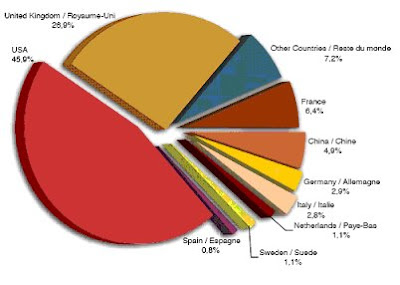
ArtPrice Report 2006
Back to our market figures, we can stress that numerous writers have analysed how the contemporary art world evolved in concordance with the culture of the members of the social relationship network within which contemporary art is produced, viewed and criticised; stressing the existence of an hegemonic power of western culture.

Big Family, Lithograph, Edition of 199, 200370cm x 82.6cm
The growth in Asian countries changes the global deal, but Chinese investors buy contemporary artworks in China, Indians in India, U.S. buy in the U.S. (also mainly due to Dollar depreciation that makes artworks 'unaffordable') and France anywhere else but in France.
I believe that this is only the first step of this 'new deal'. These changes will not only affect the content of the market, but will also change its culture: India and China will probably introduce their set of values to the contemporary art world business etiquette...
- Less differenciation (in other words we may see a low segmentation of the genres e.g. ‘expressionism’, segmented in institutionalised sub-genres such as ‘figurative expressionism’, ‘abstract expressionism’...etc);
- less hierarchisation (this means that genres won't be organised according to the value of prestige associated).
- More universalism in the art classification systems (which will also largely be enhanced by the maturity of the information transference technologies);
- finally, we may see a growing facility for artists and enterprises to move between ritualised genres.
It looks all fine to me... We may see more artists from what we used to call 'products of colonisation' affirming cultural identities without too much difficulties as the pressure resulting of not being part of what we used to call "the hegemonic western art world" may decrease.
This set of potential changes within the contemporary art world culture may therefore sign the end of the modernism... Postmodernism is only a baby... Let's hope it is a genius!

Detail from The Silk Route by Subodh Gupta ("The Damien Hirst of Dehli"-The Guardian- ArtReview). Photograph: Colin Davison
Good ole artistic trends debates may probably disappear in such conditions! No more: "My 'Nouveau Réalisme' is an answer to your 'painting and sculpture hegemony'..." or "I developed my idea of 'cubism' in reaction to your Blablablah..." Such a shame...
All these personal predictions concern the art world in market terms... What about the artists and the artworks?
Have you recently visited the Saatchi website? It now looks like a MySpace for the artists... I read in your mind that this must concern a minority as Facebook and MySpace themselves are too big to allow any serious competition... Well you may be wrong then: I read "HITS IN THE LAST 24 HOURS: 60,914,153!!!! RANK TODAY IN THE WORLD'S TOP 50.000 SITES: 227(Source: Awstats, Alexa)". It is an example among many other relevant examples. As a result of the resulting competition among artists, I see an increase of the artwork technical and aesthetic quality, already initiated by artists like Lisa Yuskavage or John Currin mentioned in the 'artwork of the month' for December in this same blog.

Jeff Koons - Model for a project... Work in progress
You can already see that artworks are more and more expensive to produce... Is it a consequence of these changes? If realized, the 161 foot tall hanging train would be located at the entrance of the Los Angeles County Museum of Art and would become a perfect illustration of the contemporary affordability to be a 'good artist' (see model above). I must admit that I am joking a bit... Koons can do it? Ok why not! It does not mean to me that someone from the other corner of the world may not impress the whole art world with a pencil, a A4 piece of paper and a great idea...
In conclusion, to YOU, the black middle class, bisexual lady from Kenya with your pencil and your A4 piece of paper... I wish you the best for 2008 and will probably see you soon in a famous contemporary art museum in China!
Happy new year everybody!
Monday, December 24, 2007

Paul McCarthy Santa Claus, Tokyo, Japan, 1996
Merry Merry Merry Merry Merry Christmas!!!Saturday, December 22, 2007
Bearlin - Mark Wallinger, bears, war protest and a pince of Turner prize
0 comments Posted by seiinod at 5:12 PM Because Berlin loves Bears... You can find thousands of them, both in very official places and in some of the oddest corners of the city. Among many of them, reappropriated by artists, advertisers and therefore tourists, the black bear on Berlin's flag is the one that conclusively binds the animal with it's cultural identity.
 Walk along Unter den Linden and try to define a taxonomy of the many "by-products" which shows the bear in countless funny situations... Mugs, T-shirts, pens, postcards... Bring something from Berlin? Bring a bear! So, what would be the ultimate tourist experience if not getting transformed into a bear?
 In the framework of his performance called 'Sleeper' (double agent in the cold-war espionage context), Mark Wallinger dressed as a bear, walked on the huge ground floor space of the Neue National gallery for ten consecutive nights.
 In fact, and although sleeper's footage is currently exhibited at Tate Liverpool, this is not this artwork that the Turner Prize jury awarded. The winner project is called State Britain and recreates the peace campaigner Brian Haw's anti-war protest in Parliament Square. You probably saw it if you visited London and therefore Big-Ben, two steps away from Brian Haw's camp. Precise in every details, from the tea-making area to the numerous banners, flags, photographs and posters, Wallinger apparently hired 14 people for six months to source the materials and carefully weather and age them to a state of complete authenticity.
Can you see the black tape line drawn on the Tate gallery's floor, behind the artist? It appears that this line defines exactly the actual zone of exclusion drawn in May 23 2006 following the passing by parliament of the Serious Organised Crime and Police Act that forbade unauthorised demonstrations within a kilometre of Parliament Square!
The artwork stands exactly on this line... How clever... Therefore, it becomes 'outlaw' but culturally approved by the government and therefore untouchable, which brings back to life the Brian Haw tools for protestation. Moreover, it attracts the attention of the media and demonstrates how art and language can be powerful!
Wednesday, December 19, 2007
Who does what? A short reflection on the role of the actors of the contemporary art market
0 comments Posted by seiinod at 10:08 PMRight at the heart of the art market are the buyers of artworks. Completing the offer and intermediaries in the market scheme, they finally decide on the success of a trend or an artist. The English reference magazine ART REVIEW draws a map depicting the geographical distribution of power within the contemporary art world every year. The French Collector François Pinault was classified being the first most influential art player in the world in 2006 by the above mentioned magazine (in the Power 100 Issue) whereas the first artists appearing in the ranking are Bruce Nauman and Jeff Koons occupying only the 9th and 10th position.
Consultants enable actors in the art world, gallerists in particular, to gain access to information concerning the market. They also are the ones who may give access to the “grey” market where artworks are sold privately by one collector to another without passing through a dealer or an auction house.
 In his book "Collecting contemporary", Adam Lindermann argues that museum staffs facilitate the emergence of an artist’s reputation and the evolution of trends: “There is no doubt that the Paul McCarthy (one of the 24 artists represented in the ArtReview classification mentioned above) retrospective organised by Lisa Phillips and Dan Cameron (belonging to the museum staff) a few years ago at the New Museum of contemporary art in new-York confirms that this seminal but long under appreciated artist was going to develop a real commercial market”.
In this context, Carole Duncan in Aesthetic of Power
 highlights that an artwork would only be recognised as ‘high art’ on the international scene if one of its network members treats it as art. Therefore, “In order to become visible in this world, an artist must make work that in some way addresses the highest community or some segment of it”. In other words, the message and its form have to match the expectancies of the intermediaries in terms of communication.
 Sunday, December 16, 2007

With True Blonde Draped (1999) she depicts a poignant portrait of a blond hair girl who seems crushed by something not directly painted on the canvas... But Lisa Yuskavage gives us clues about her situation:
Let’s first have a look on the background. The saturated red color, fills heavily every inches of the frame with sexual connotations.
Her ruffled hair and her naked body under the bedding indicates that the scene takes probably place after the sexual act. She significantly protects her crotch with both clasped hands. Beautiful, ...she is, she is an exact compromise between sexual icon (blond hair, pulpy with a huge breast) and ordinary (shadows on her face, blunt nose, unsteady breast). She is the victim of a voyeurism act that YOU, the viewer, perpetrate. Prisoner of the canvas, of the tainted surrounding air and prisoner of her own attributes... Her beauty is her burden, heavily symbolised by her breast. She is trapped!
This stereotype that shapes the cage of our True Drapped Blonde is central in Yuskavage paintings and I invite you to have a look on the flickr diaporama available on the right column of this blog to discover more of her amazing artworks.

Technically, Lisa's work is recognized as particularly impressive among connoisseurs: She apparently uses models to study lights and shadows; photos to frame the paintings, her work is so impressive technically (paint strokes, mastering of light effects...etc.) that specialised art press often compare her to Renaissance masters (No joking).
To replace her work in a more general art world background, she is often associated with artists such as John Currin (Google his name on Google image or click there to go on the BBC website or slate.com, you ll see the similarities by yourself), Luc Tuymans and Elizabeth Peyton in the 1990's, reaching superstar status after reinserting figuration in the art world.
 Lisa Yuskavage is currently represented by David Zwirner, New York and greengrassi, London.
 Call it kitsch, call it soft-porn, call it gorgeous, sexy, weird or embarrassing, appealing or repulsive, Lisa yuskavage paintings shake the art world... but what about you?
So...? Do you like it? Do not forget to vote on the right hand side column of this blog!!!!
;-)
Today was the last day to vote for the artwork of the month and you were 15 to vote... Not that bad if you consider that in one month of existence, this blog attracted 163 Visitors (48 unique visitors from 12 different countries) for a rate of 5.26 Visits / Day!
But now, let's talk a bit about the artwork of the month... The results for the Murakami's 'Hommage to Francis Bacon' were:
- 50% Funky Soul Baby
- 42% Groovy for sure
- 7% Not the type of artwork I d hang on my living room wall
- 0% Rather listening to Enya
I am glad you like it!!! Something tells me that we will have to come back to Murakami quite regularly regarding to his actuality!!!
Wednesday, December 12, 2007
I say fair enough... Did you see this crack? Did you see this skull? amazing aren't they?!!
The first is a work commissioned by the Tate gallery and is only viewable in Tate modern because it's part of it. This 548ft crack called Shibboleth is here to show how the foundations of the contemporary art world are fragile. Cracking the ground floor of the HUGE turbine hall of the Tate modern was particularly clever in this sense: Tate modern is one of the biggest touristic attractions in London, one of the coolest brand (15th on the coolbrands classification... Do not believe me? Check yourself: http://www.superbrands.uk.com/pdfs/CB%20-%20Press%20Release%20-%20Announcement%20-%20Final.pdf) and a centre of gravity for the contemporary art. Cracking its foundation suggests that the contemporary art culture was built upon colonialist values and cultural imposition. "Shibboleth asks questions about the interaction of sculpture and space, about architecture and the values it enshrines, and about the shaky ideological foundations on which Western notions of modernity are built" in Salcedo's own words.
 Although the media criticize on the one hand that visitors keep on asking to the staff "how did the artist do that?!" and keep on falling in the crack... (A dozen of accidents reported!); on the other hand, to quote Jonathan Jones from the Guardian Art blog "it is a fissure that doesn't really threaten anything or anyone".
Moreover, he says "Modern art has now become the universal culture of Britain's middle class, of all ages. Yet when a really provocative and powerful contemporary work appears - I'm talking about Damien Hirst's diamond skull - the middle class runs for cover, disturbed by the impossibility of reducing this disturbing object to a liberal platitude".
Photograph: Getty
And here comes our second Artwork: Damien Hirst's Diamond Skull. For me there is nothing controversial about it. I can imagine that it may shake the common mood but honestly, having a look back in the 90's on Tracey Emin's bed, it may suffer the comparison. Remember, she brought her own bed covered of alcohol, germs and traces of her sexual activity... In Saatchi's gallery. Ok! Ok! Nothing to do with the skull, but that rocked! didn't it?

My Bed by Tracey Emin, 1998. Photograph: courtesy Jay Jopling/White Cube.
Here lies the problem. Contemporary art became popular, fashionable, cool (look at this whole blog: I do not think I m the first writing a blog about contemporary art, believing that my view got the spark that will lead me to a Worldwide Web rapid success!) And my generation acknowledged the existence of contemporary art with artists like Emin, Chapman brothers and a pope crushed by a rock came from space. In fact my first memorable artwork was the empty room presented for the Turner Prize by Martin Creed (Work No. 227: The lights going on and off 2000 (installation at Tate Britain)5 seconds on/5 seconds off, Edition 2/electrical time). In fact I found it controversial enough to bring it on the top of my hobby list... Can you imagine now why a skull and diamonds are not controversial to me? Is it controversial to you?

Courtesy Cabinet, London © GBE (Modern) New York Photo: Tate Photography
-John! come here! Take a picture of us in front of this... hmm... Nazi's cross model representing hell, crafted by the Chapman brothers!!!
Yep! Chapman's are cool too nowadays!
ART should be challenging and provocative... But please do not provoke us for free... We are bored anyway, it's all done! ;-))
http://blogs.guardian.co.uk/art/2007/12/hirst.html
http://blogs.independent.co.uk/independent/2007/10/salcedos-crack-.html
http://www.tate.org.uk/modern/exhibitions/dorissalcedo/default.shtm


